What Are the Most Common Fogging Machine Chemical Names?
Looking for the best fogging machine chemical? Explore the full 2026 name list — deltamethrin, malathion, pyrethrum & more with prices, safety & mixing tips.
Every pest control operator, municipal fogging team, and farmer running a fogger eventually asks the same question: which chemical actually goes inside the tank? Understanding the correct chemical names for fogging machines is not just paperwork; it determines whether a fogging round kills mosquitoes effectively or just creates a dramatic cloud that pests avoid for a few minutes before coming right back once the smoke clears. From government-approved formulations used in city-wide dengue drives to farm-grade insecticides sprayed across paddy fields, every chemical name carries its own dilution ratio, target pest, and safety rule that a fogging team should know by heart, not just guess at on drive day.
Being a trusted thermal fogging machine manufacturer in India, 100x circle private limited gets this question daily from PCOs, dealers, and Nagar Nigam officials placing their next chemical order. This guide breaks it all down in simple, desi language, covering the full list of names, which one suits which job, and where to be extra careful, so nobody loads the wrong bottle before switching the machine on.
Fogging Machine Chemical Name List Every Buyer Should Know
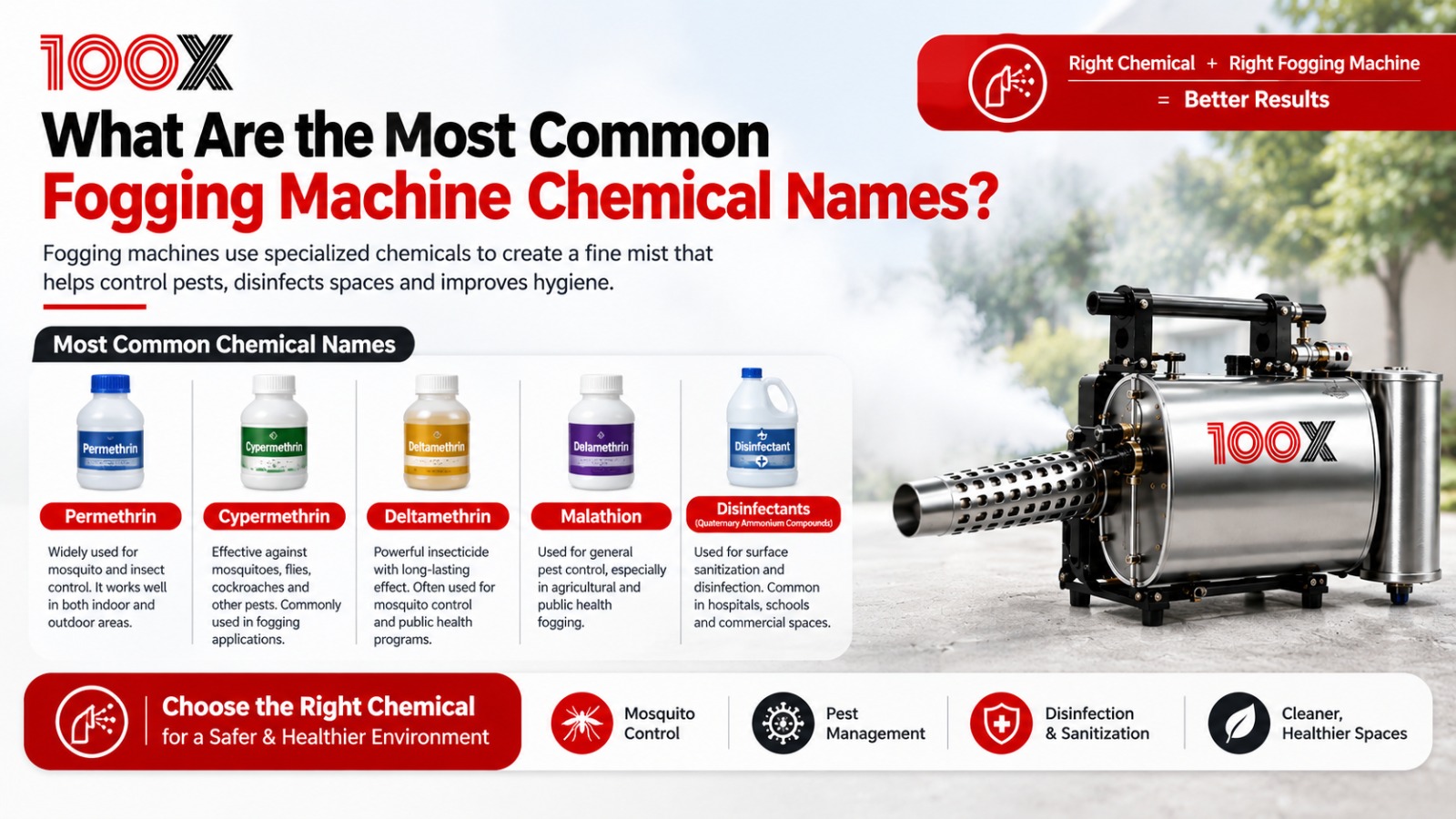
Before comparing brands or bargaining on price, it helps to have one clear list of fogging machine chemical names in front of you. Indian pest control and vector control programs mostly rely on a handful of proven active ingredients, each suited to a different job, whether that is a monsoon dengue drive, a warehouse fumigation round, or a routine farm spray schedule. Our earlier guide on what chemicals and solutions are used in fogging covers the diesel-and-chemical carrier system in more depth, but here is the short version every fogger owner should keep handy on their phone.
Why Every Fogger Owner Needs This List Handy?
Buying the wrong chemical wastes diesel, wastes labour hours, and in the worst case fails to control the very outbreak it was meant for. Municipal tenders, GeM listings, and private pest control contracts often specify the exact active ingredient and concentration on paper, so getting the name wrong at the procurement stage can delay an entire order by weeks. Field teams who keep this list on their phone or on a notice board near the machine store rarely end up loading the wrong drum before a drive, and that small habit alone saves a lot of rework.
- Deltamethrin 1.25% ULV, a synthetic pyrethroid used in most municipal dengue and chikungunya drives across India.
- Malathion 5% or 96% technical grade, an older organophosphate still used for large-area outbreak response.
- Pyrethrum extract 2% concentration, a plant-based option preferred wherever low chemical residue is needed.
- Cypermethrin 10% EC, an oil-compatible formulation common in warehouse and industrial estate fogging.
- Deltamethrin 2% EW , water-based insecticide concentrate for application as a space spray adulticide in the management of adult mosquitoes.
- D-allethrin, a fast knockdown active often blended with a longer-lasting chemical for quicker visible results.
- Permethrin and cyfluthrin, less common overall but sometimes named specifically in export or defence tenders.
Keep this list next to the machine's user manual, since dilution ratios shift slightly with every change in formulation strength or brand, even when the chemical name on the label looks the same.
What Is the Best Chemical for Mosquito Fogging Machine Operators?
There is no single, one-size-fits-all answer here, because the best chemical for mosquito fogging machine work depends heavily on the target insect, the type of area being treated, and the resistance pattern that has built up locally over years of spraying the same product again and again. What works well for an open municipal drain may not be the right pick for an enclosed godown, a school compound, or a hospital ward where families and patients are close by, and treating every job the same way usually backfires sooner or later.
Factors That Decide the Right Fit for Your Area
Four things usually decide the final choice: the insect species and its documented resistance history, whether the space being treated is indoor or outdoor, how much chemical residue is acceptable in that setting, and the budget approved for that particular spray cycle. Government dengue drives usually specify deltamethrin because resistance data for it is tracked closely by state health departments, while private pest control firms sometimes rotate between two or three chemicals on purpose to avoid resistance building up in the local mosquito population. Knowing the accurate chemical name before the team fills the tank prevents a wrong dilution ratio, which either wastes expensive chemical or, worse, fails to knock down the target pest at all.
Deltamethrin Fogging Chemical and Cypermethrin Fogging Solution Compared
Two names come up in almost every fogging conversation across India: deltamethrin and cypermethrin. Both are synthetic pyrethroids, both mix cleanly with diesel or kerosene as a carrier liquid, and both are approved for public health use by Indian authorities, yet the two behave quite differently once they leave the nozzle and settle over an area.
How Deltamethrin Performs Outdoors?
A deltamethrin fogging chemical at 1.25% ULV strength is the most widely specified option in municipal tenders because it delivers a strong, fast knockdown effect on Aedes and Anopheles mosquitoes along with a well-documented safety profile for large open-air drives. Most Nagar Nigam and Nagar Palika contracts across states like Bihar, Uttar Pradesh, and Haryana name deltamethrin by name in their tender documents, which is exactly why 100x Circle machines are factory calibrated to handle this formulation smoothly right out of the box, with no extra nozzle adjustment needed on delivery.
Where Cypermethrin Works Best?
A cypermethrin fogging solution tends to be the preferred option for warehouses, cold storage units, and industrial estates where a slightly stronger residual effect on crawling insects, and not only flying mosquitoes, is needed. It stays oil-compatible, which suits pulse-jet thermal fogging machines well, and pest control companies often lean toward it for godown fumigation contracts where repeat insect entry through loading bays is an ongoing headache season after season.
Malathion, Pyrethrum & D-allethrin Fogging Chemicals for Special Jobs
Beyond the two most talked-about names, three more chemicals show up often enough on Indian tenders and shop shelves that every buyer should be able to recognise them instantly, even if they use them less frequently.
Malathion for Large-Scale Outbreak Control
A malathion fogging chemical, usually applied at around 5% concentration for space spraying, has been used for decades across India during major outbreak response efforts because it is cheap in bulk, widely stocked, and easy to source quickly during an emergency procurement window. It does carry a noticeably stronger smell than the newer pyrethroids, which is one reason it is typically reserved for open outdoor drives rather than indoor fogging jobs, especially in residential colonies.
Pyrethrum and D-allethrin for Sensitive Areas
A pyrethrum fogging liquid is plant-derived, breaks down quickly under sunlight, and is often the chosen option for hospitals, schools, and food-handling areas where a low-residue formulation matters more than a long-lasting kill effect. A D-allethrin fogging chemical, on the other hand, is prized for its extremely fast knockdown speed and is frequently blended with a longer-acting chemical to give both an instant visible result and lasting control over the following hours. Farmers running fogging alongside their regular agricultural fogging equipment routine should always double-check which of these actives is safe near flowering crops before switching on the machine, since a wrong choice at bloom time can hurt pollinators.
Common Fogging Chemicals: Uses, Base Type & Popular Brands
Final Thoughts
Getting the fogging machine chemical names right, matching each one to the correct dilution ratio, and running it through a well-maintained machine is really what decides whether a fogging round works properly or just looks impressive for the photographs. Whether the job in front of your team is a city-wide dengue drive, a warehouse fumigation contract, or a routine farm spray schedule, keep a copy of this chemical name list within reach and always follow the label's mixing instructions rather than guessing by eye.
If safety around household fogging is a bigger concern for you, our detailed guide on whether mosquito fogging is harmful walks through the health risks and safer alternatives step by step. For machines engineered to handle every formulation on this list reliably, season after season, 100x circle pvt ltd remains one of India's most trusted GeM-approved OEMs for thermal fogging equipment.
Frequently Asked Questions
1. Which chemical is most commonly used in Indian municipal fogging machines?
Deltamethrin at 1.25% ULV strength is the most widely used chemical in municipal fogging drives across India.
2. Can I mix two fogging chemicals together in one tank?
Mixing chemicals without manufacturer or health department guidance is not recommended, since it can affect dilution accuracy and safety.
3. Is pyrethrum safer than synthetic chemicals like cypermethrin?
Pyrethrum, being a plant extract, breaks down faster in sunlight and leaves less residue, making it a common choice for low-residue indoor spaces.
4. Do all fogging machine chemicals work with diesel as a carrier?
Most oil-based formulations like deltamethrin, cypermethrin, and malathion mix well with diesel or kerosene carriers in thermal foggers.
5. How do I know which chemical is approved for my fogging machine?
Check the WHO Prequalified list and Central Insecticide Board, India approval list. Also check local health department guidelines, since approved chemicals vary slightly by state and application.
Ansita Sahu
Article Author