How to Procure Fogging Machines Through the GeM Portal
Learn how to buy a fogging machine on GeM. Understand Direct Buy, L1 comparative buying, bid, purchase limits and Q1-Q4 categories.
Buying a fogging machine for a municipality, hospital or army unit is no longer a matter of calling three shops. Most departments now buy a fogging machine on GeM, the government e-marketplace, where prices, specifications, and sellers sit in one place. If you are a first-time buyer, the portal can look confusing. Should you use direct buy, L1 or a bid? What do Q1, Q2, Q3 and Q4 mean? This guide answers each question in simple steps, so you can complete your purchase with confidence.
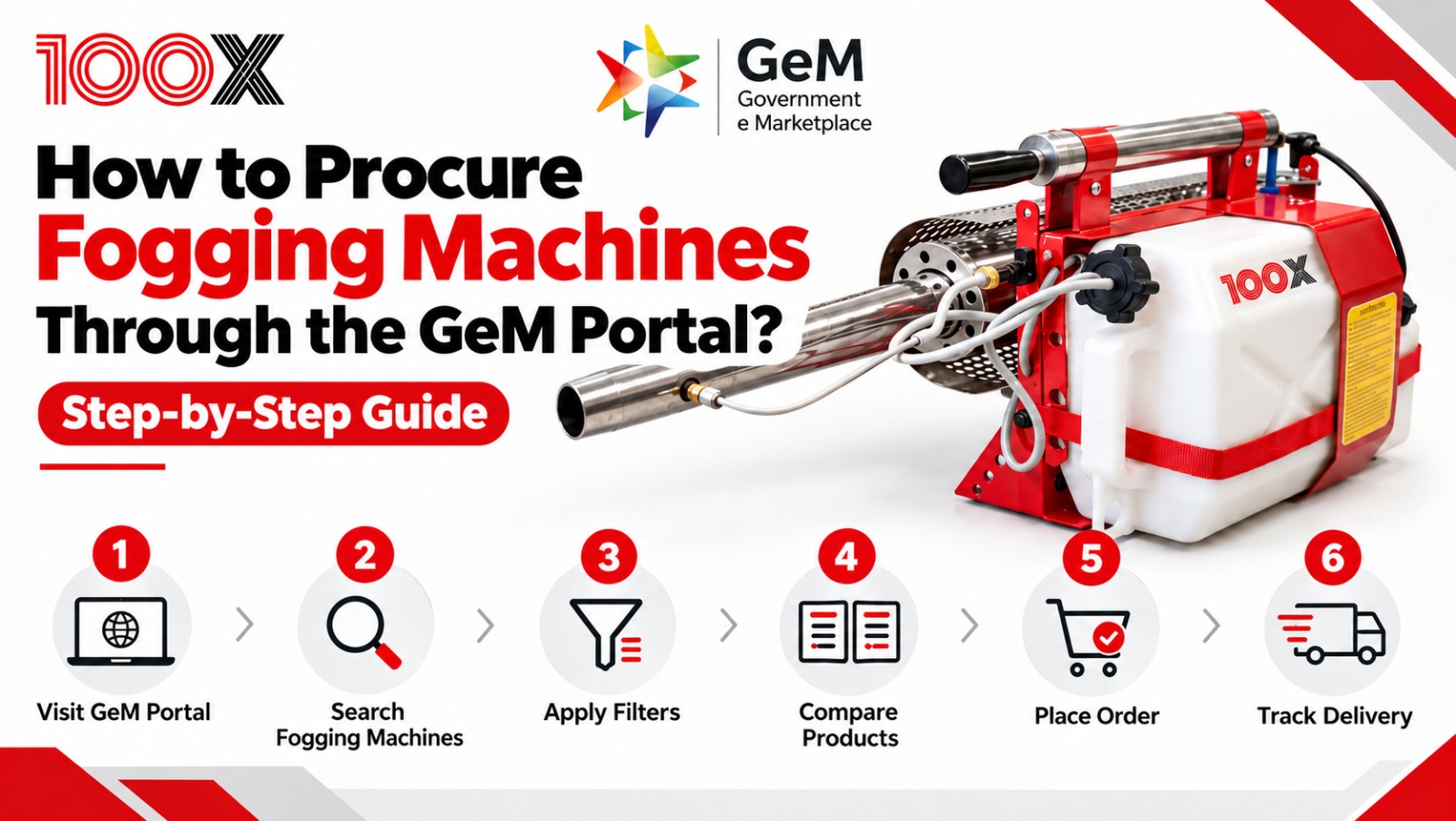
Government e-Marketplace Fogging Machine: Step-by-Step Buying Process
A government e-marketplace fogging machine purchase follows the same basic flow whether you need one handheld unit or fifty vehicle-mountable units. GeM is run by the Government of India, and registered buyers such as ministries, state departments, municipal bodies and public sector units can use it. Before you start, decide your quantity, the type of machine and the standard it must meet. Most government buyers look for IS 14855 compliance and an ISI marked machine, so keep that in your specification.
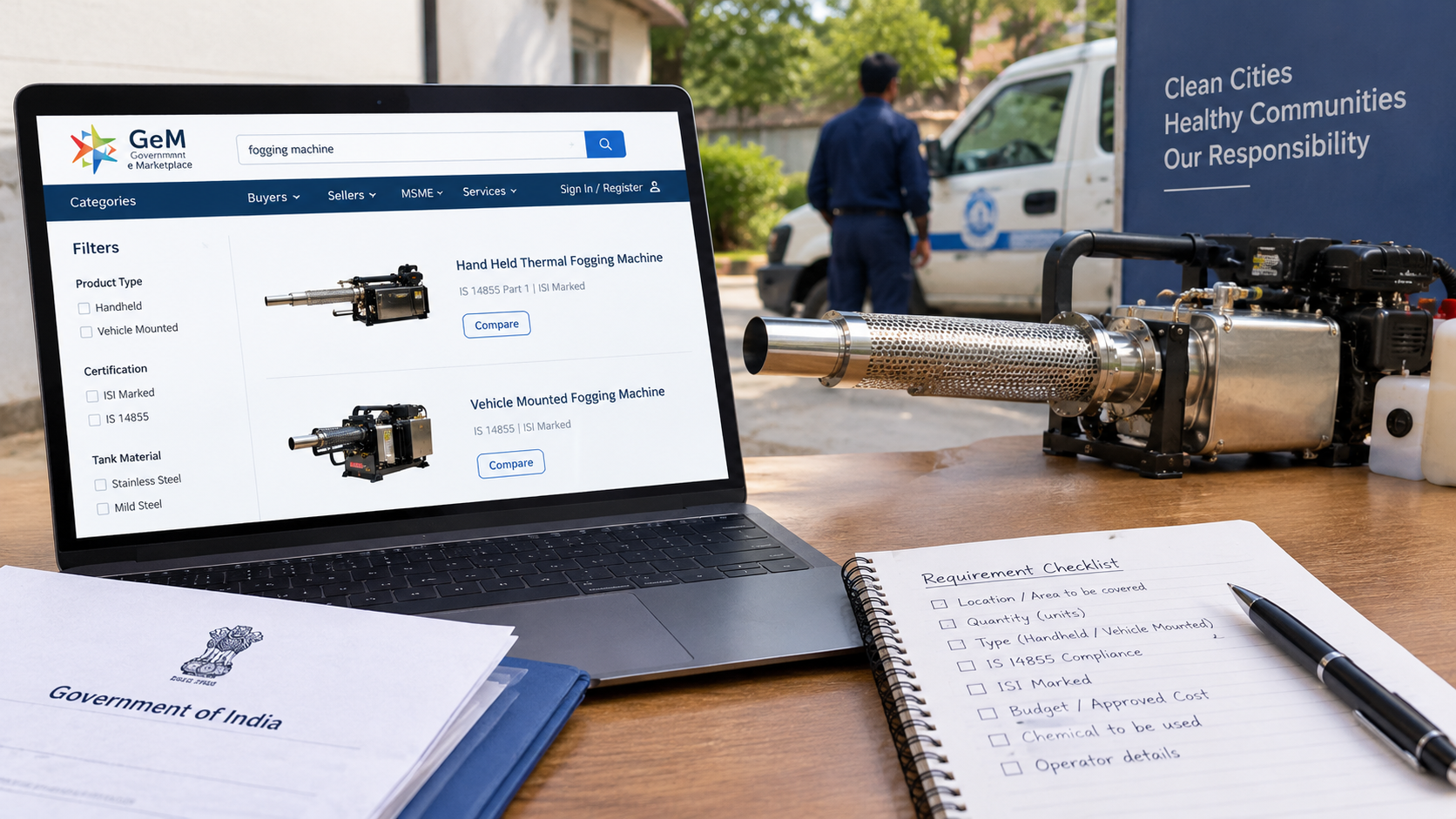
Before You Log In: Prepare Your Requirement
Good purchases start offline. Write down where the machine will be used, how many hectares or wards it must cover, who will operate it and which chemical you plan to use. Decide whether you need a hand carried or vehicle mounted model, and note the budget approved by your department. A clear requirement sheet saves hours on the portal and prevents wrong orders.
Step 1: Log In and Search the Category
Log in with your buyer account and search for the fogging machine category. The portal lists catalogues for hand carried and vehicle mountable thermal foggers, and some listings even name IS 14855 Part 1 in the title. Use the filters for machine type, tank material, starting method and certification so that the results match your need.
Step 2: Compare Specifications and Documents
Open each listing and go through the technical details one by one: engine output, chemical discharge capacity, tank material, noise level, how long the machine runs without refuelling, and the warranty. Then confirm the basics of compliance, which are a BIS licence number, the ISI mark and a type test report. If you’re still deciding whether a handheld or a vehicle-mounted machine suits your area, check different types of fogging machines.
Step 3: Choose the Purchase Route
The route depends on your order value. Direct purchase, L1 comparison and bidding each have their own limits, which the next section explains. The portal shows the correct option for your budget, so you rarely need to guess. If your value is near a limit, ask your finance wing which route applies.
Step 4: Place the Order and Track Delivery
After selection, the buyer generates a contract with the delivery period and consignee details. The seller dispatches the machine, and the consignee issues a receipt and acceptance certificate once the goods are checked. Payment is then released through the portal, which keeps the whole process transparent.
Step 5: Inspect, Accept and Rate the Seller
When the machine arrives, check the model, serial number, ISI mark, accessories and manuals against the order. Run a short test with water if your rules allow. Accept the goods only after the checks are done, and rate the seller honestly, because ratings help other departments choose reliable suppliers.
Direct Buy GeM, L1 Comparison and Bid: What Are the Purchase Limits?
Government rules fix the route for each order value, and the same limits apply to a fogging machine on GeM as to other goods. The direct buy GeM route is the simplest, but it has a ceiling, and the other two routes take over as the order value grows.
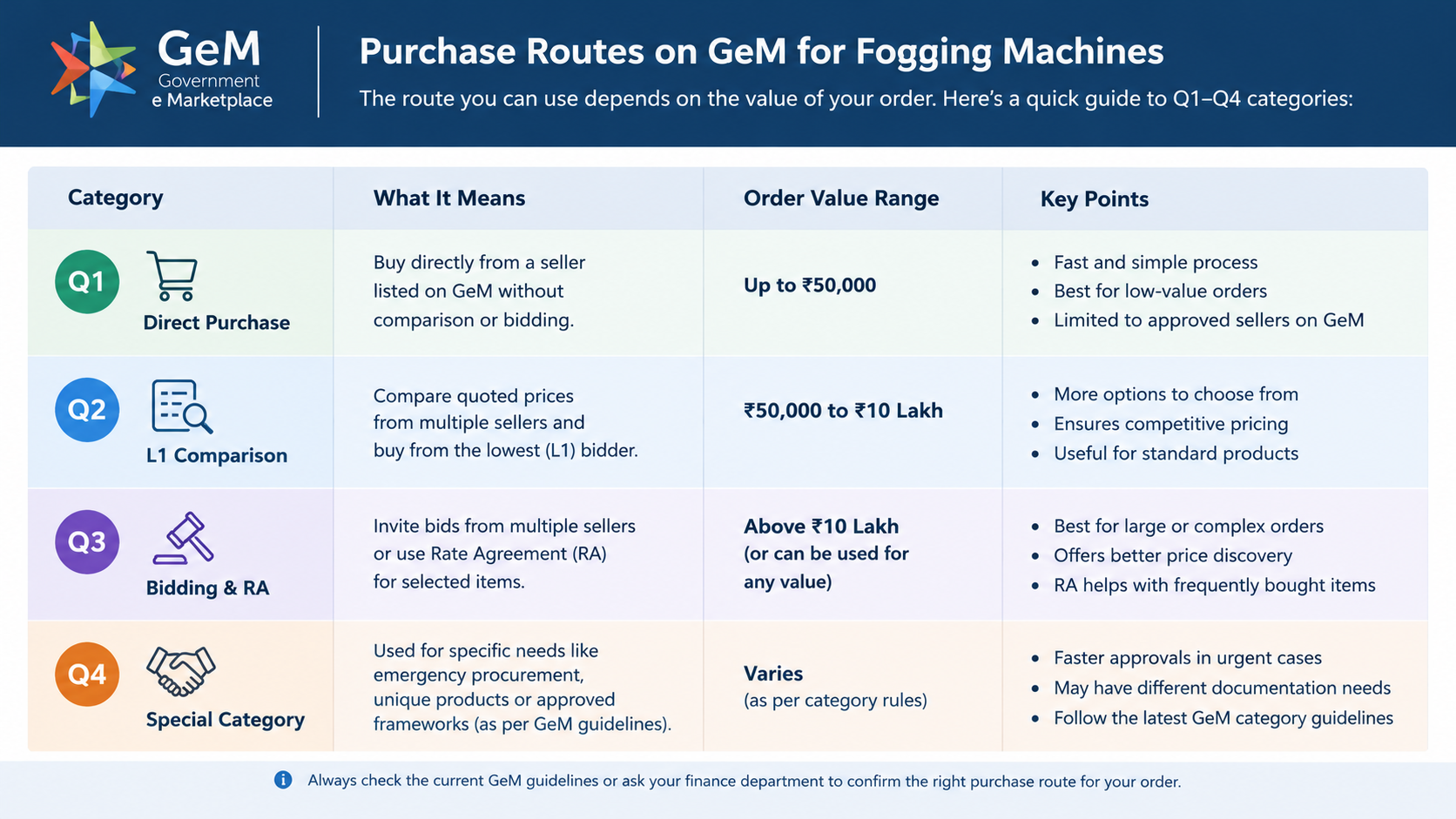
Direct Buy: Up to ₹50,000
Direct purchase lets a buyer order from any available seller that meets the required quality, specification and delivery period, without comparing prices. The limit is ₹50,000 per order. It suits a single mini fogger or a small spare parts purchase for a ward office. Splitting a bigger requirement into small orders to stay under the limit is not allowed.
L1 Comparative Buying: ₹50,000 to ₹10,00,000
For orders above ₹50,000 and up to ₹10,00,000, the buyer compares at least three different OEMs or service providers who meet the requirement, then picks the lowest price, called L1. L1 simply stands for the lowest one. If several products sit at the same L1 price, the buyer may choose any of them. This route often fits a ward level purchase of two or three thermal foggers.
Bid and Reverse Auction: Above ₹10,00,000
Orders above ₹10,00,000 go through a bid or reverse auction. The buyer publishes the requirement, sellers submit offers within a set period, and the contract usually goes to the lowest technically qualified seller. Large city programmes for vehicle mounted foggers commonly use this route.
Limits Can Change
These limits come from the GeM help pages and the General Financial Rules, and the Department of Expenditure can amend them. Always confirm the current limits on the portal or with your finance wing before you plan a purchase. A printed note of the current slabs in your office helps every officer work from the same numbers.
Which Route Fits Which Order?
A few examples make the limits easier to remember. A school or small hospital buying one mini fogger usually stays within direct purchase. A Nagar Panchayat buying three portable thermal foggers for ward drives often lands in the L1 range. A district programme buying a fleet of vehicle mounted machines almost always needs a bid. Plan your quantity early, because the total value of the requirement decides the route.
Purchase Methods and Value Limits
| Purchase Method | Purchase Value Limit | Description |
|---|---|---|
| Direct Purchase | Up to ₹50,000 | Goods or services can be purchased directly within the specified limit, subject to applicable procurement rules and approval requirements. |
| L1 Comparative Buying | Above ₹50,000 up to ₹10 lakh | Compare quotations or offers from multiple eligible sellers and award the purchase to the L1 bidder (lowest-priced eligible bidder), subject to the applicable terms and conditions. |
| Bidding & Reverse Auction (RA) | Above ₹10 lakh, or for any value | Use a competitive bidding process to invite offers from sellers. In a Reverse Auction (RA), eligible sellers compete by reducing their prices, helping identify a competitive final offer. |
Note: These limits are based on the procurement thresholds provided. The applicable procurement policy, tender conditions, approval requirements, and platform-specific rules should be checked before selecting a purchase method.
GeM Fogging Machine Price and the Q1, Q2, Q3 and Q4 Categories
The GeM fogging machine price depends on engine output, tank material, starting system, warranty and whether the unit is hand-carried or vehicle-mounted. Some portable pulse jet listings on the portal have shown prices between about ₹45,000 and ₹96,000, but prices change often, so always check live listings.
What do Q1, Q2, Q3 and Q4 Mean & what are V1, V2, and V3?
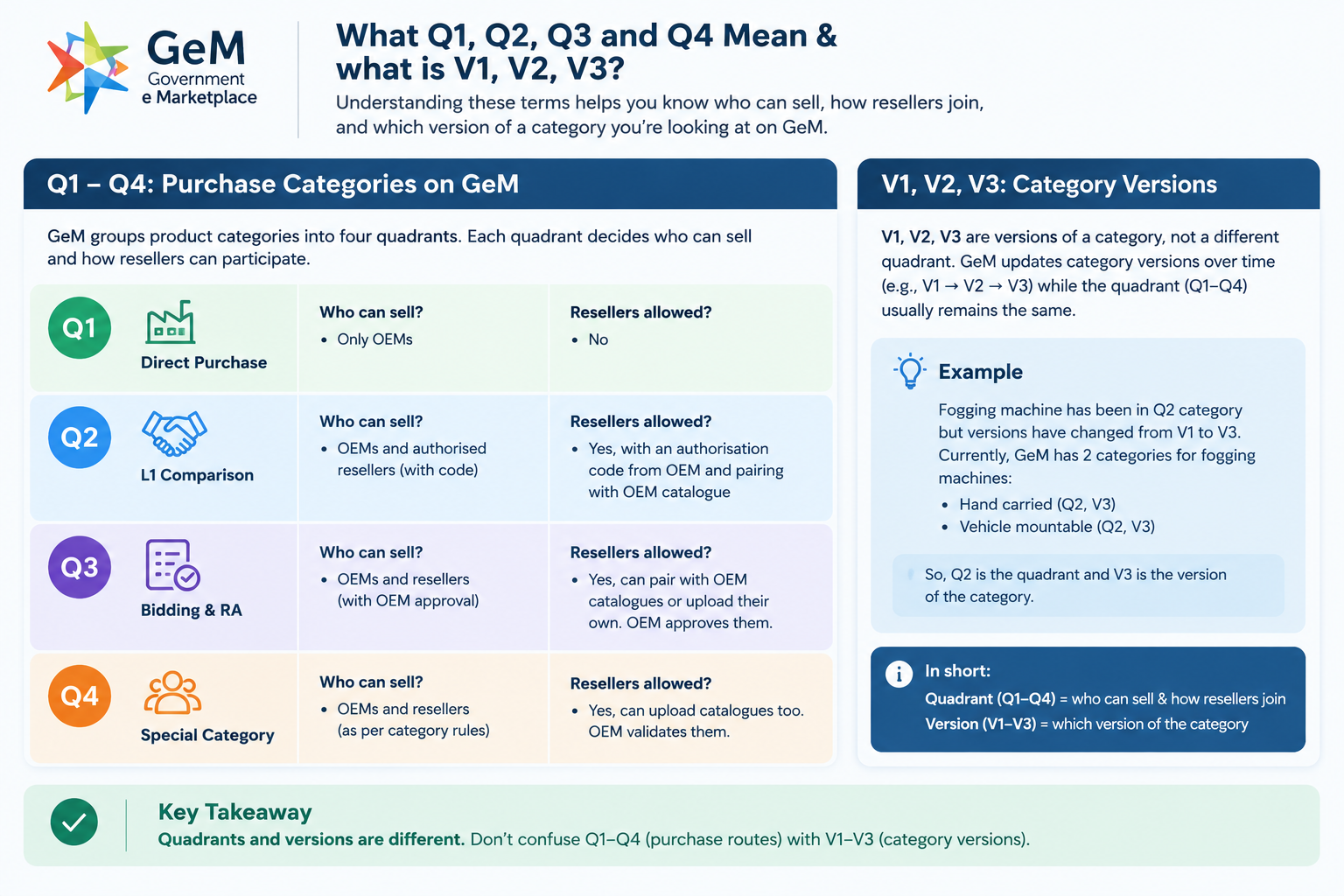
GeM groups product categories into quadrants that decide who can sell and how resellers join. In Q1, only OEMs can sell and resellers are not allowed. In Q2, resellers need an authorisation code from the OEM and pair with the OEM catalogue. In Q3, resellers can pair with OEM catalogues or upload their own, and the OEM approves them. In Q4, resellers can upload catalogues too, and the OEM validates them. GeM uses six quadrants in all, but Q1 to Q4 matter most for goods such as machines.
Please note here that Quadrants and variants are different. While the quadrant depicts the GeM groups, V1, V2, V3 mentioned in the category name are the versions of the category. Older categories move from V1 to V2 to V3 and so on, but their quadrant category remains the same.
For example, fogging machines have been in the Q2 category, but versions have changed from V1 to V3. Currently, fogging machines are divided into 2 categories on GeM hand-carryable and vehicle-mountable, both in Q2, but their version is V3.
So, Quadrants Q1-Q4 must not be confused with versions V1-V3.
Why Quadrants Matter When You Buy?
For a buyer, the quadrant shows how much control the manufacturer has. Where the maker stands behind the listing, the risk of fake spares or unsupported machines drops. Check the quadrant of your category and ask the seller whether it is an OEM or an authorized reseller. This is one reason many buyers prefer a genuine manufacturer such as 100x circle private limited, which also gives dealers a valid GeM reseller code.
Compare Like for Like
A low price means little if two machines are not equal. Compare tank capacity, output per hour, tank material, starting method, certification, warranty and delivery time side by side. Add the running cost of fuel, chemical and spare parts to the purchase price.
Fogging Machine Tender GeM: Bid Process and Documents to Check
A fogging machine tender GeM bid is used for larger orders, such as a city wide mosquito control programme. The buyer writes the technical specification, and sellers must prove that they meet each point.
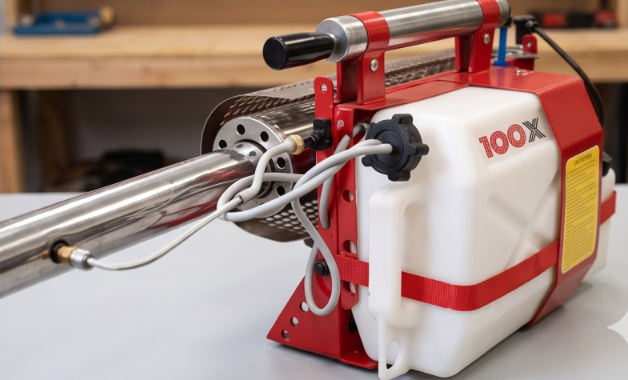
How a GeM Bid Works?
The buyer publishes the bid with the quantity, delivery period, specification and required documents. Sellers submit their price and papers before the closing date. Technical evaluation comes first, and only qualified sellers move to the price stage, where the lowest offer wins. A reverse auction may follow among the qualified sellers.
Documents Buyers Usually Ask For:
- Standard compliance: IS 14855 (Part 1) compliance and a valid BIS licence for the ISI mark.
- Test report: A type test report from an ILAC, NABL or central government lab.
- Authorisation: An OEM authorisation letter, or a reseller code for dealers.
- Quality papers: ISO 9001 and MSME certificates where they apply.
- Support details: Warranty, spare parts list, operation manual and past supply records.
Smart Tips Before You Bid or Buy
Write the specification clearly and avoid brand specific words, so that more qualified sellers can compete. Plan chemical and fuel supply along with the machine. Understanding the uses of a thermal fogging machine can help you identify the right specifications for your needs. 100x circle private limited also help with GeM ready documents and tender support, which saves time when the closing date is near.
Common Mistakes in GeM Bids
Vague specifications attract unsuitable offers, so describe the machine type, capacity and standard clearly. Do not ignore certification, because an uncertified machine can fail at inspection and delay a public health drive. Avoid unrealistic delivery periods, especially before the monsoon season, when demand peaks. Finally, read every clause of the bid document before submitting, since a missing paper can cancel an otherwise strong offer.
Conclusion
Keep a checklist of your requirement, your budget slab and your documents before every order. A little planning at the start prevents delays, rejections and rework, and it helps your department stay audit ready.
Buying a fogging machine on GeM is easy once you know the three routes, their limits and the quadrant rules. Fix your specification, check certification and compare offers carefully before you decide. If you want a GeM approved Indian OEM with ISI marked models and tender documents ready, 100x circle private limited is a dependable place to start.
Frequently Asked Questions
What is the direct buy limit on GeM?
Direct purchase is allowed up to ₹50,000 per order without price comparison.
What is L1 buying on GeM?
L1 buying lets a buyer compare at least three OEMs or service providers for orders between ₹50,000 and ₹10,00,000 and choose the lowest price.
When is a bid or reverse auction required on GeM?
Orders above ₹10,00,000 normally need a bid or reverse auction, but bid can be of any value.
What are Q1, Q2, Q3 and Q4 categories on GeM?
They are quadrants that decide whether OEMs, authorised resellers or both can sell in a category.
What are V1, V2, V3 and V4 mentioned in categories on GeM?
They are Versions of category. As category gets revised their versions move from V1 to v2 to v3 and so on. Versions are not be confused with Quadrants Q1,Q2,Q3,Q4
Which standard should a fogging machine meet for government purchase?
Most government buyers look for IS 14855 (Part 1) compliance with a valid ISI mark.
Ansita Sahu
Article Author