What are the different types of fogging machines?
Confused between thermal and cold fogging machines? Compare all types of fogging machines by use case, droplet size, and application before you buy.
If you are comparing the different types of fogging machines available in India before buying one, you are not alone. Households, pest control operators, farms, Residents housing societies and municipal health departments all have different needs, and a single machine rarely suits every situation. Some buyers need a compact unit for a courtyard, while others need equipment that can cover an entire ward before sunrise. Understanding which category fits your requirement helps you avoid an expensive mismatch.
This guide breaks down every major category, so you can shortlist with confidence instead of guessing from a price list alone. By the end, you'll know exactly which category fits your coverage area, chemical needs, and budget
Thermal Fogging vs Cold Fogging: What's the Real Difference?
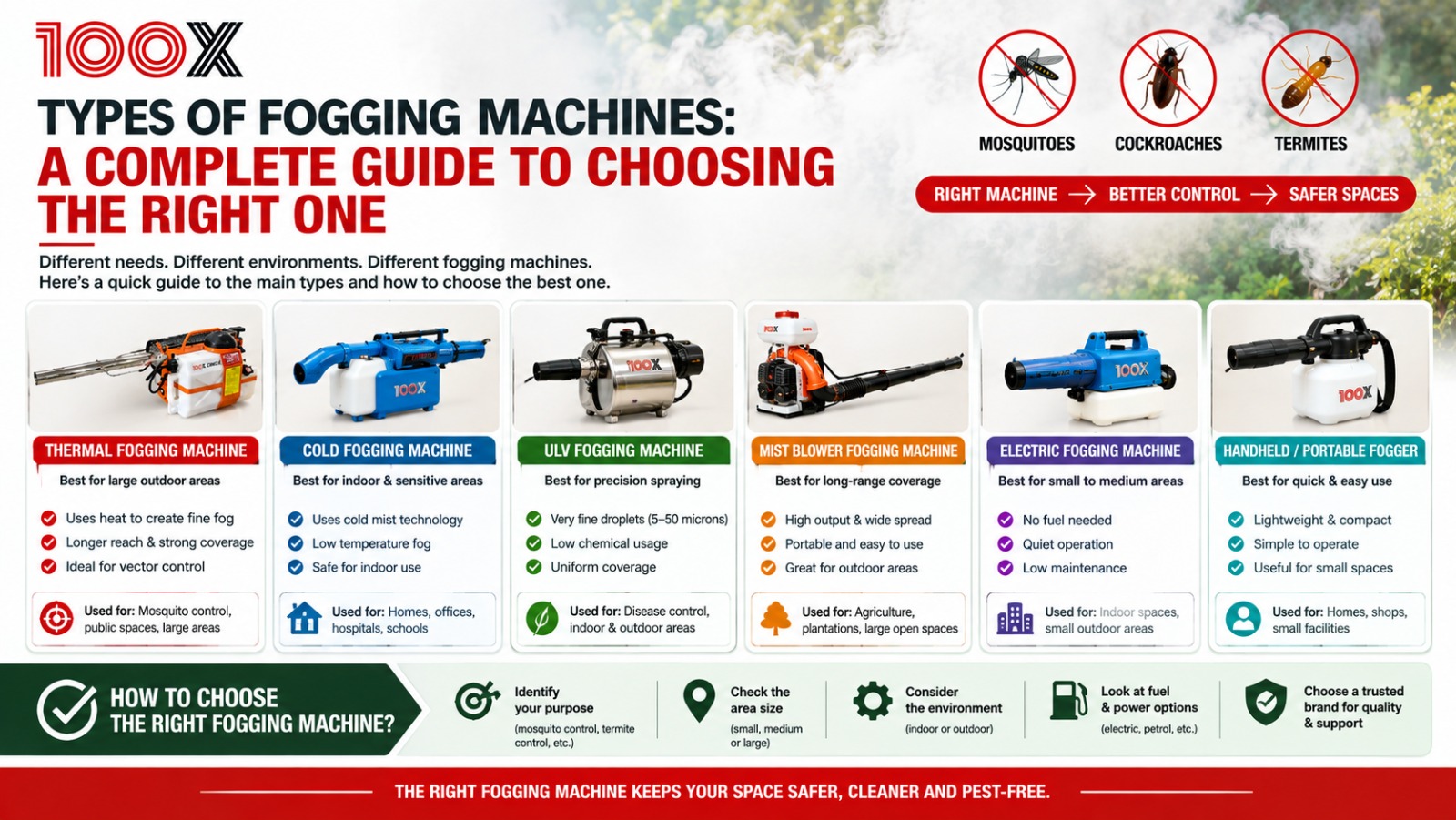
The most fundamental difference between fogging machines is how they generate fine droplets. A thermal fogging machine uses the hot exhaust stream from a pulse jet engine to break the treatment solution into very fine droplets. As the solution exits the nozzle and meets cooler surrounding air, it condenses into a dense, visible fog.
A cold fogging machine, on the other hand, does not use a heat stream. It relies on mechanical atomization to break the liquid into fine droplets. Depending on the machine design, this may involve high-pressure air, a high-speed rotating component, an air compressor, engine, pump, or specialized nozzle.
Both types of machines are used for different applications. Thermal fogging is commonly associated with large outdoor pest-control and mosquito-control applications where dense, visible fog is preferred, while cold fogging is used across suitable indoor and outdoor applications where mechanical atomization and controlled mist distribution are required.
How a Thermal Fogging Machine Works?
A thermal fogging machine uses a pulse jet engine and its hot exhaust stream to break the treatment solution into very fine droplets. The solution exits through the nozzle and meets cooler surrounding air, where it condenses into a dense, visible fog.
This fog-generation process is commonly used for outdoor pest control, mosquito control, agricultural pest management, and other large-area applications where a dense and visible fog is useful for distribution.
Tank Materials in Thermal Fogging Machines
When choosing a thermal fogging machine, the tank material is another important specification to consider. Common options include CRC (Cold Rolled Carbon Steel i.e Iron ), SS (Stainless Steel), and HDPE (High-Density Polyethylene). CRC tanks offer a strong metal construction but require appropriate protection against corrosion, particularly when exposed to moisture and chemical formulations. Stainless steel tanks provide good corrosion resistance, although they can be heavier and prone to leakages from welded joints. HDPE is generally the preferred option for most users because it combines lightweight construction, corrosion resistance, low maintenance, and good resistance to many commonly used chemical formulations. Its lighter weight can also make portable machines easier to handle. However, buyers should always confirm that the specific formulation being used is compatible with the tank material before purchase.
Manual vs. Automatic Starting System
The starting system is another variable buyers should consider when selecting a fogging machine. Machines are commonly available with manual or automatic starting systems. A manual-start machine can be a suitable choice for experienced pest-control professionals who are already familiar with operating combustion-based equipment. An automatic-start system, on the other hand, makes starting more convenient and is particularly suitable for new or occasional users who may prefer simpler operation. Therefore, professionals who are comfortable with conventional starting mechanisms can consider manual systems, while first-time buyers may find an automatic-start machine easier to operate.
Rechargeable Li-ion vs. Dry-Cell Battery System
The battery system is another specification to compare, particularly when choosing a fogging machine with an electric starting mechanism. Buyers may come across rechargeable and dry-cell battery systems. It is important to understand that the battery does not continuously power the fogging operation. Similar to a car, the battery is primarily used to start the engine; once the fuel-powered engine starts, the machine runs on fuel, which is petrol. Rechargeable batteries can be convenient for users who operate the machine frequently and have access to charging facilities. Dry-cell batteries can be a more convenient option for users who do not want to recharge the battery, since there is no regular charging requirement and the cell can simply be replaced when depleted. For professionals or high-field use, this can make dry-cell systems a practical choice.
How a Cold Fogging Machine Works?
Cold or ULV fogging machines use mechanical atomization to create fine droplets without relying on a heated exhaust stream. Cold fogging describes the method of mechanically breaking liquid into droplets, while ULV (Ultra-Low Volume) refers to an application approach that uses a relatively small quantity of concentrated liquid for area coverage. Cold fogging machines are commonly used for ULV applications, although some thermal fogging machines can also be configured for ULV use.
Because there is no heating process involved, cold fogging can be used with formulations that are specifically approved for cold application. The resulting fine mist can be used across suitable indoor and outdoor treatment areas, depending on the formulation, machine specifications, and application requirements.
Vehicle-Mounted Fogging Machine for Large-Area Coverage
When the area to be covered spans several kilometres of road, a handheld unit is simply not practical. A vehicle-mounted fogging machine is built to be fixed onto a truck, tractor, or trolley, allowing a two-person team to fog an entire municipal ward or an industrial estate in a single pass. These machines usually carry a larger fuel and chemical tank, a stronger pulse-jet engine, and a longer throw distance than portable models.
When Municipal Bodies Need Vehicle-Mounted Units?
Nagar Nigams, Nagar Palikas, and Panchayats running seasonal dengue and malaria control drives rely on vehicle-mountable machines because ward-level coverage before dawn is only possible at higher output and speed than a handheld fogger can match.
Fuel and Tank Considerations
Larger tanks reduce refuelling stops during a long drive, and stainless steel construction resists corrosion from repeated exposure to WHO-approved chemical formulations over a full fogging season.
Mounting hardware matters just as much as the engine. A poorly secured unit vibrates loose on uneven municipal roads, which shortens the life of fittings and hoses. Look for a mounting frame rated for the vehicle type it will sit on, along with an accessible fuel gauge and chemical-level indicator so the operator can plan refuelling stops without stopping the drive midway through a ward.
Mini Fogging Machine and NHM Fogging Machine Options for Smaller Jobs
Not every job needs industrial-scale equipment. A mini fogging machine is a lightweight, single-operator unit designed for home gardens, small farms, and compact housing societies where a full vehicle-mounted setup would be overkill. On the government side, a NHM fogging machine refers to units procured under National Health Mission guidelines for district-level vector control, and these typically need to meet IS 14855 and GeM compliance standards before they can be supplied to health departments.
Mini Fogging Machine for Homes and Small Farms
These compact units are easy to carry, quick to refuel, and simple enough for a single person to operate without prior training, which makes them popular with resident welfare associations and small orchard owners. They typically hold a smaller chemical charge, which is more than adequate for a courtyard, a nursery, or a few rows of crops, and the lower fuel consumption keeps running costs manageable for occasional use rather than daily deployment.
NHM Fogging Machine for Government Health Programmes
Before shortlisting a machine for a government tender or health department procurement, it helps to confirm the following:
- Valid GeM listing and reseller authorization for the model
- IS 14855 compliance certificate from the manufacturer
- Documented spare parts availability across the buyer's state
- Warranty terms covering the combustion chamber and pump
- Past performance record with similar government departments
Choosing the Right Mosquito Fogging Equipment
With so many categories available, choosing the right mosquito fogging equipment & machines comes down to matching the machine to your actual working conditions rather than chasing the lowest price. A wide range of fogging machines exists precisely because a housing society, a municipal corporation, and a farm each face a different coverage problem, and no single design solves all three equally well. Treat the category as a starting filter rather than the final decision: once you know whether you need thermal or cold output, and whether the job calls for a handheld, mini, or vehicle-mounted build, the remaining choice becomes a straightforward comparison of tank size, and after-sales support between a handful of shortlisted models.
Matching Machine Type to Your Use Case
Large open outdoor areas often favour thermal fogging when a dense, visible fog is required, while cold fogging can be suitable for indoor and outdoor applications where fine mechanical atomization is preferred. The choice should also consider the treatment formulation, required droplet characteristics, coverage area, power or fuel availability, and the manufacturer's recommendations.
What to Check Before You Buy?
Always verify tank material, warranty coverage, chemical compatibility, and whether the supplier can service the unit. A cheaper machine that sits idle during peak season ends up costing more than a slightly pricier, well-supported one.
It also helps to speak with existing operators in your region before finalising a purchase. Someone who has already run a particular model through a full monsoon season can tell you how the fog output holds up after repeated refuelling, how easily the nozzle clogs, and whether local technicians genuinely stock spare parts or simply promise to order them on request. That kind of ground-level feedback often reveals more about long-term reliability than any specification sheet.
Conclusion
Every category of fogging equipments exists to solve a specific coverage problem, and knowing the types of fogging machines available is the first step to buying the right one instead of the cheapest one. Being fogging machine manufacturers in India, 100x circle private limited manufactures and supplies thermal, cold, portable, and vehicle-mounted fogging machines built for Indian conditions, backed by GeM-ready documentation and nationwide after-sales support.
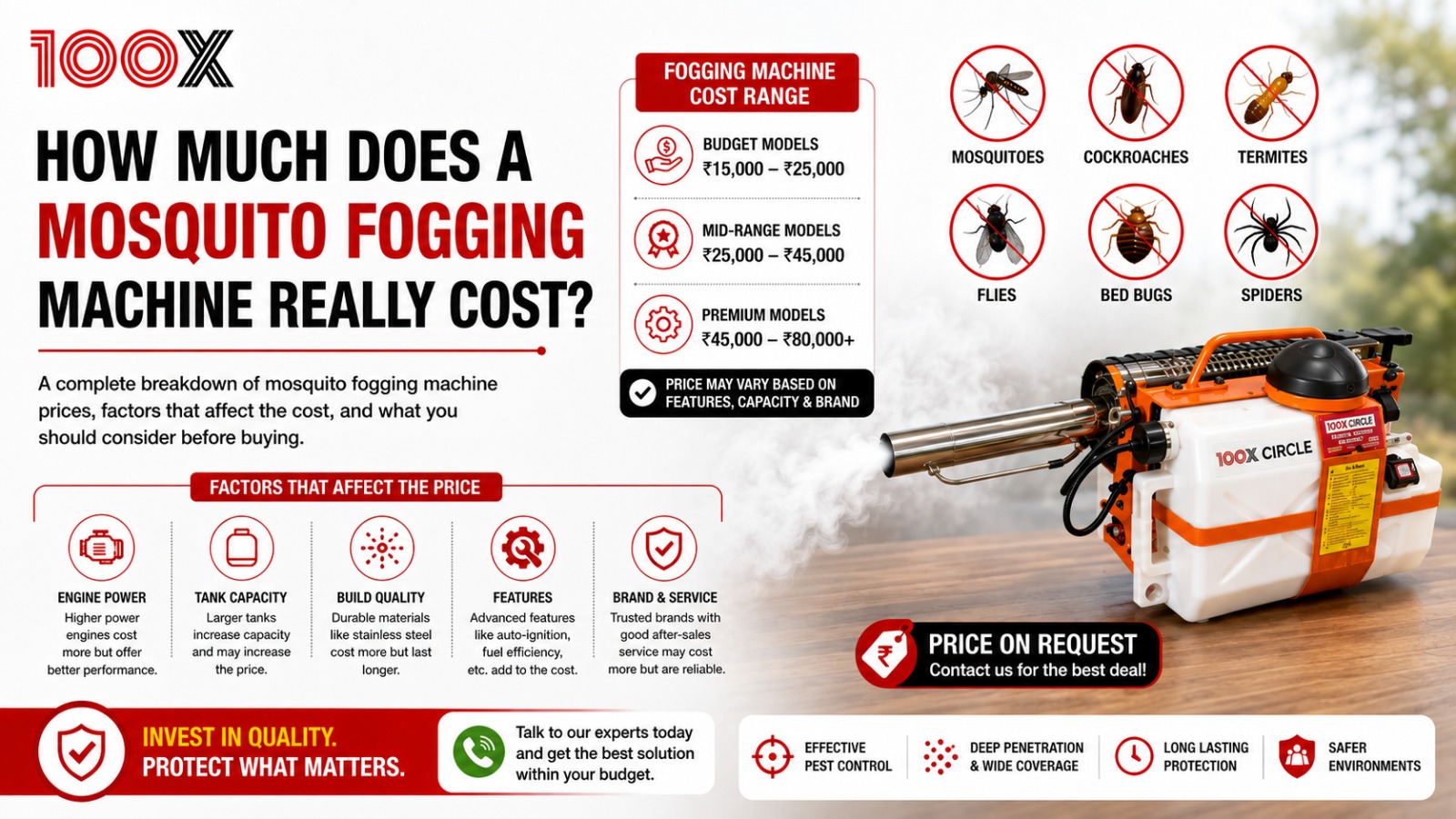
For a closer look at what drives pricing across categories, see this related guide on how much a mosquito fogging machine really costs.
Frequently Asked Questions
What are the main types of fogging machines available in India?
Common categories include thermal fogging machines, cold fogging or ULV machines, portable and mini fogging machines, and vehicle-mounted fogging equipment. The appropriate category depends on the application, treatment area, required droplet characteristics, and equipment configuration.
Is a thermal fogging machine better than a cold fogging machine?
Thermal units offer greater reach for outdoor vector control, while cold units are safer for indoor and occupied-space disinfection.
When is a vehicle-mounted fogging machine necessary?
It is necessary when covering large municipal wards, industrial estates, or several kilometres of road in a single fogging drive.
What makes a machine eligible as an NHM fogging machine?
Eligibility generally requires IS 14855 compliance, a valid GeM listing, and documentation meeting National Health Mission procurement standards.
Is a mini fogging machine suitable for home use?
Yes, a mini fogging machine is lightweight and simple enough for single-operator use in homes, gardens, and small farms.
Ansita Sahu
Article Author