5 Key Industries That Require High-Performance Thermal Foggers
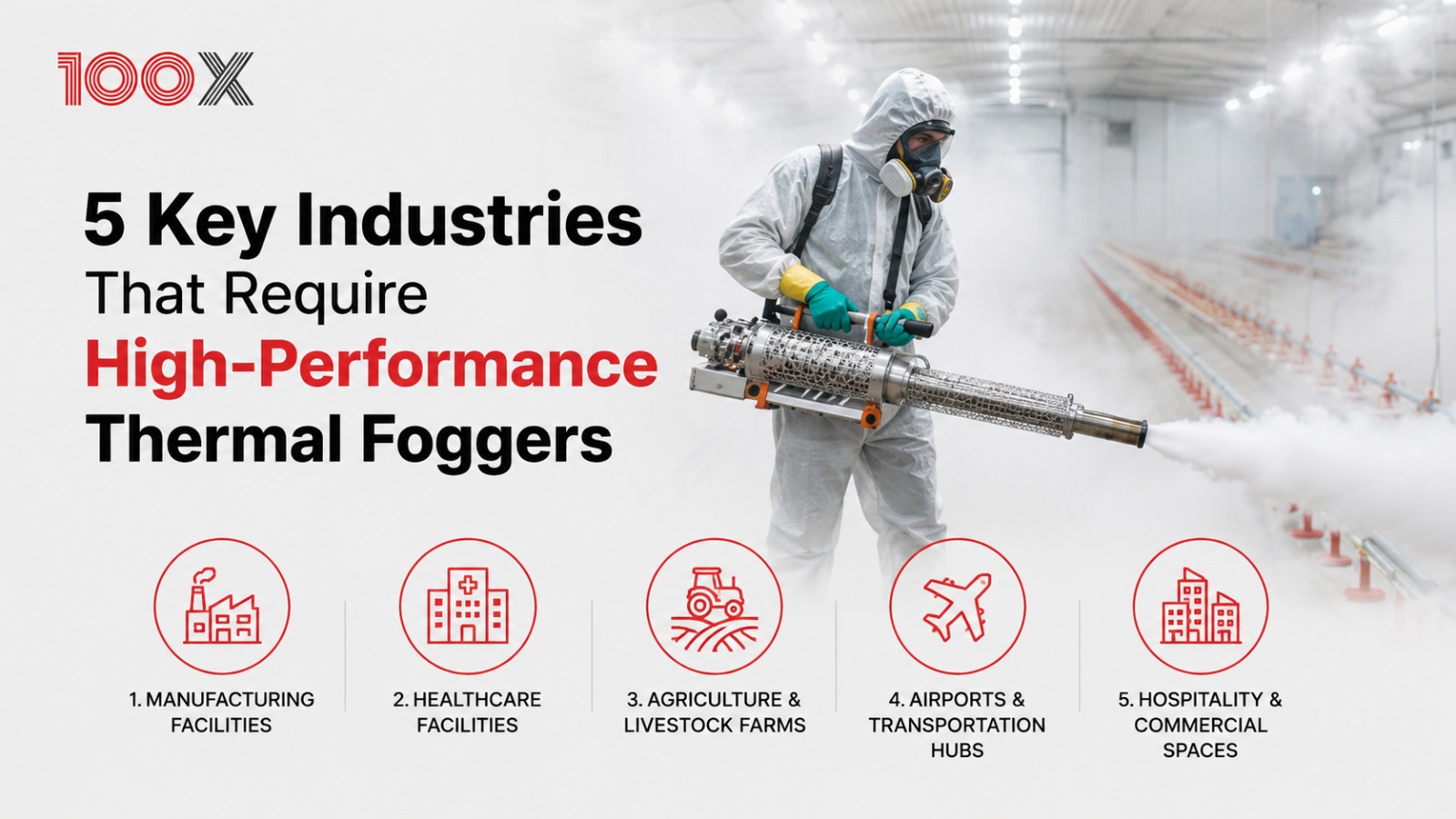
5 Key Industries That Require High-Performance Thermal Foggers
When it comes to controlling mosquitoes, pests, pathogens, and airborne contaminants at scale, not every method cuts it. Spraying by hand is slow. Cold fogging covers limited ground. That is exactly why so many businesses today are switching to high-output thermal fogging systems.
The list of industries using thermal fogging sprayer machines has grown significantly in recent years, driven by rising health compliance demands, wider facility footprints, and the need to treat large spaces quickly and thoroughly. From farms to food plants to hospitals, the need for effective fogging is no longer a niche concern.
In this article, we break down the 5 industries where thermal foggers have become an essential operational tool, and why getting the equipment specification right matters more than ever in 2026.
1. Agriculture: Fighting Pests Before They Cost You the Season
Few industries feel the pressure of pest damage as acutely as agriculture. A single uncontrolled aphid or whitefly infestation across a 10-acre vegetable crop can wipe out weeks of effort almost overnight. Farmers and agri-businesses have been relying on
agricultural pest control equipment 2026 increasingly centres around thermal foggers because of one critical advantage: penetration. The ultra-fine fog particles produced by a thermal fogger reach deep inside plant canopies, under leaf structures, and into soil crevices that conventional sprayers simply cannot access.
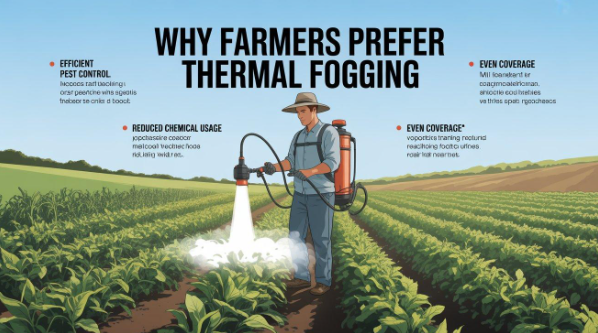
Why Farmers Prefer Thermal Fogging
• Speed: A single operator can treat 2 to 5 acres per hour, depending on the fogger model.
• Coverage: Fog reaches areas where sprayer nozzles fail, including high-canopy orchards and dense row crops.
• Chemical efficiency: Thermal fogging uses significantly less pesticide volume to treat the same area.
• Versatility: Works with fungicides, insecticides, and plant growth regulators.
Beyond row crops, poultry farms and aquaculture facilities also rely on thermal foggers for routine disinfection between production cycles. This overlap with industrial grade foggers for animal husbandry makes this category one of the highest-volume segments for fogging equipment in India.
With the Government of India pushing precision agriculture adoption and the threat of climate-linked pest pressure rising, demand for high-performance agricultural foggers is only going to climb through 2026 and beyond.
2. Public Health and Vector Control: Where Scale and Speed Save Lives
In densely populated urban zones, disease outbreaks can spread at a frightening pace. Dengue, malaria, chikungunya, and other vector-borne illnesses have turned municipal vector control into a matter of genuine public urgency, not just routine maintenance.
This is the domain where public health vector control solutions must perform at their peak. Thermal foggers are the tool of choice for Urban Local bodies - Nagar Nigams, municipal corporations, and state health departments across India because they can treat entire city blocks, drainage corridors, and dense slum settlements within hours.
Key Applications in Vector Control
• Mosquito eradication drives: Especially effective during monsoon and post-monsoon periods.
• Dengue prevention campaigns: Thermal fogging is used both as a preventive and emergency-response measure.
• Flood-affected area sanitation: Post-flood disinfection of waterlogged streets and temporary shelters.
• Epidemic response: Rapid deployment in containment zones during disease outbreaks.
Vehicle-mounted foggers have become particularly important for these agencies, allowing crews to cover 15 to 20 kilometres of urban roads during a single night operation. The ability to fog at speed while maintaining uniform particle distribution is something no alternative equipment can match at this scale.
This is also the segment where government procurement, GeM approvals, and institutional buying play a central role. Manufacturers who can supply certified, compliant foggers at volume have a clear edge in this space.
3. Warehousing and Logistics: Disinfection at Industrial Scale
The post-pandemic era fundamentally changed how warehouses and logistics hubs approach hygiene. What was once a quarterly fumigation exercise has become a weekly or even daily protocol for many high-throughput facilities.
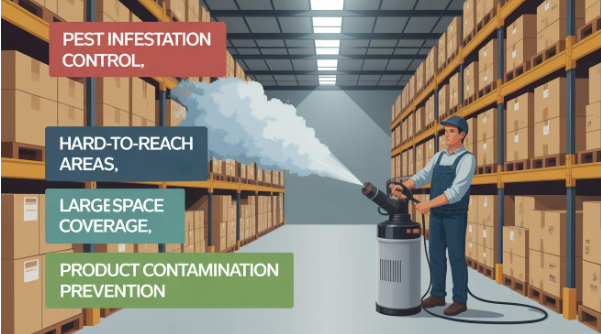
Warehouse and logistics disinfection now demands equipment that can treat large, open floor areas quickly, reach racking systems at height, and leave no wet residue that could damage inventory or delay operations. Thermal foggers check every one of these boxes.
Common Challenges Thermal Foggers Solve in Warehousing
• Height coverage: Fog rises and disperses naturally, reaching the top of 10 to 15-metre racking structures.
• Speed of treatment: A 10,000 sq ft warehouse can typically be fogged in under 30 minutes.
• Rodent and insect control: Stored-product pest control is critical in food-grade and pharmaceutical warehouses.
• Residue-free finish: The dry fog output avoids moisture damage to packaging, electronics, or paper goods.
E-commerce fulfilment centres, cold-chain logistics hubs, and bonded warehouses near ports are among the heaviest users of thermal fogging equipment today. With India's logistics sector growing at over 10% annually, demand from this segment is robust and consistent.
Fogging service providers who supply to this sector also need to comply with ISO, and international food safety standards, which makes certified, documentation-ready equipment a necessity rather than a preference.
4. Animal Husbandry: Protecting Livestock and Revenue
Livestock operations, whether poultry, dairy, piggery, or fisheries, deal with biosecurity challenges that most people outside the sector rarely think about. A single outbreak of Newcastle disease, foot-and-mouth disease, or avian influenza can result in losses running into crores of rupees within days.
This is why industrial grade foggers for animal husbandry have become standard equipment on serious livestock farms. Thermal fogging allows for rapid, deep sanitation of sheds, coops, pens, and processing areas in a way that manual sanitation simply cannot replicate.
How Thermal Fogging Protects Livestock Facilities
• Between-batch disinfection: Thorough fogging between production cycles eliminates pathogens before new stock is introduced.
• Parasite control: Effective against lice, mites, flies, and other ectoparasites that harm productivity.
• Feed area sanitation: Prevents mould and bacterial growth in storage and feeding zones.
• Water source protection: Fogging reduces contamination risks near drinking troughs and water lines.
In India's rapidly scaling poultry sector, where over 4,000 million broiler chickens are produced annually, the ROI from proper biosecurity fogging is straightforward. One prevented disease cycle justifies months of fogging costs many times over.
Thermal foggers designed specifically for animal husbandry also need to be compatible with veterinary-approved disinfectants, and robust enough to handle the dusty, humid conditions typical of farm environments. This is where build quality and component selection become critical differentiators.
5. Commercial Sanitation and Contract Cleaning: The Service Industry Standard
Pest control companies, facility management firms, and professional cleaning contractors have quietly become one of the biggest buyers of high-performance thermal foggers over the past five years. The reason is straightforward: clients now expect more.
Hotels, hospitals, shopping malls, schools, and corporate campuses all demand documented, certifiable commercial sanitation and contract cleaning services that can demonstrate actual results. A thermal fogger gives service providers the ability to treat large, complex spaces thoroughly and generate the client-facing documentation that supports contract renewals and compliance audits.
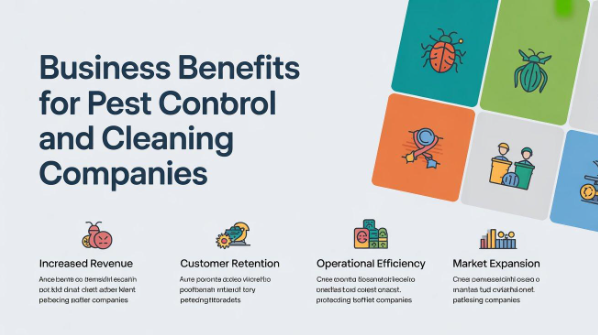
Business Benefits for Pest Control and Cleaning Companies
• Higher billing potential: Fogging is a premium add-on service that significantly boosts per-visit revenue.
• Client retention: Demonstrable, fast results build client confidence and reduce churn.
• Competitive differentiation: Operators who offer thermal fogging stand apart in a crowded service market.
• Multiple verticals: A single fogger can serve hospitals, food courts, gyms, and residential complexes.
India's organised pest management industry is currently valued at over Rs. 3,500 crore and growing at 15% year-on-year. Service businesses that invest in the right equipment today are positioning themselves for the contracts that the next phase of growth will bring.
For contract cleaners and disinfection service providers, the ability to handle public health vector control solutions as part of a broader service offering also opens doors to municipal and institutional contracts that individual homeowners simply cannot access.
What to Look For When Choosing a Thermal Fogger for Your Industry
Not all foggers are built the same, and the right choice depends heavily on the application. Here are the core specifications worth evaluating before any purchase decision:
• Engine type and fuel efficiency: Pulse jet engines deliver high output with lower fuel consumption over extended runs.
• Tank capacity: For large-scale operations, tanks of 5 litres or more reduce refill interruptions.
• Fog particle size: Particles in the 8 to 20-micron range achieve the deepest penetration and longest air suspension.
• Chemical compatibility: Confirm compatibility with pesticides, disinfectants, and agricultural chemicals you intend to use.
• Portability vs. mounting: Handheld foggers work well for targeted applications; vehicle-mounted models are best for area-wide coverage.
• Build quality: HDPE corrosion free Tanks and heat-resistant components ensure longevity in harsh environments.
For operations across multiple sectors, investing in a versatile, industrial-grade fogger pays back quickly in operational time savings and reduced repeat treatments.
Why Getting the Right Equipment Partner Matters
Across all five industries discussed above, one pattern holds true: the quality of the fogging machine directly determines the quality of the outcome. Underpowered equipment means inadequate fog distribution. Poorly built machines mean frequent breakdowns at the worst possible times.
This is why leading operators across India, from municipal health departments to large poultry integrators, look to established manufacturers who combine technical capability with strong after-sales support. 100X Circle offers a comprehensive range of thermal foggers designed specifically for the demanding conditions found in these industries, built on pulse jet technology and optimised for reliable field performance.
Whether you are evaluating equipment for the first time or looking to upgrade your current fleet, aligning with a manufacturer who understands your operational context makes all the difference.
Final Thoughts
The growing adoption of industries using thermal fogging machines across agriculture, public health, logistics, animal husbandry, and commercial sanitation reflects a broader shift toward faster, more effective, and more accountable operational hygiene standards.
As compliance requirements tighten and client expectations rise, the industries that get their fogging infrastructure right early will hold a clear operational advantage. Equally, service businesses and operators who invest in high-performance equipment position themselves for the contracts and opportunities that the next wave of industry growth will bring.
If you are assessing options for any of these sectors, explore the full range of agricultural pest control equipment 2026-ready solutions and industrial foggers available at 100x Circle. The right equipment, backed by the right support, is the foundation every serious operation needs.
Frequently Asked Questions (FAQs)
Q1. Which industries benefit most from thermal fogging machines?
The top five sectors relying on thermal foggers are agriculture, public health and vector control, warehousing and logistics, animal husbandry, and commercial sanitation services, each using them for pest control, disinfection, or biosecurity.
Q2. How is a thermal fogger different from a cold fogger?
A thermal fogger heats the chemical solution to create a dense, penetrating smoke-like fog with very fine particle sizes (5 to 20 microns), making it far more effective for deep coverage in large or complex spaces compared to cold foggers, which produce larger droplets with shorter suspension time.
Q3. Can one thermal fogger work across multiple industries?
Yes, most industrial-grade thermal foggers are versatile enough to handle pesticides, disinfectants, and fungicides, making them suitable for use across agriculture, warehousing, animal farms, and commercial sanitation with the right chemical formulations.
Q4. How often should thermal fogging be done in warehouses?
Frequency depends on inventory type and compliance requirements, but most food-grade, pharmaceutical, and high-traffic warehouses implement fogging on a weekly or fortnightly schedule, with additional treatments after pest sightings or during peak infestation seasons.
Q5. What safety precautions are needed when operating a thermal fogger?
Operators should always wear appropriate PPE, including masks, gloves, and eye protection; ensure the area is evacuated before fogging begins, follow manufacturer guidelines on chemical dilution rates, and allow adequate ventilation time before re-entry based on the chemical used.
Related Images
100X
Article Author