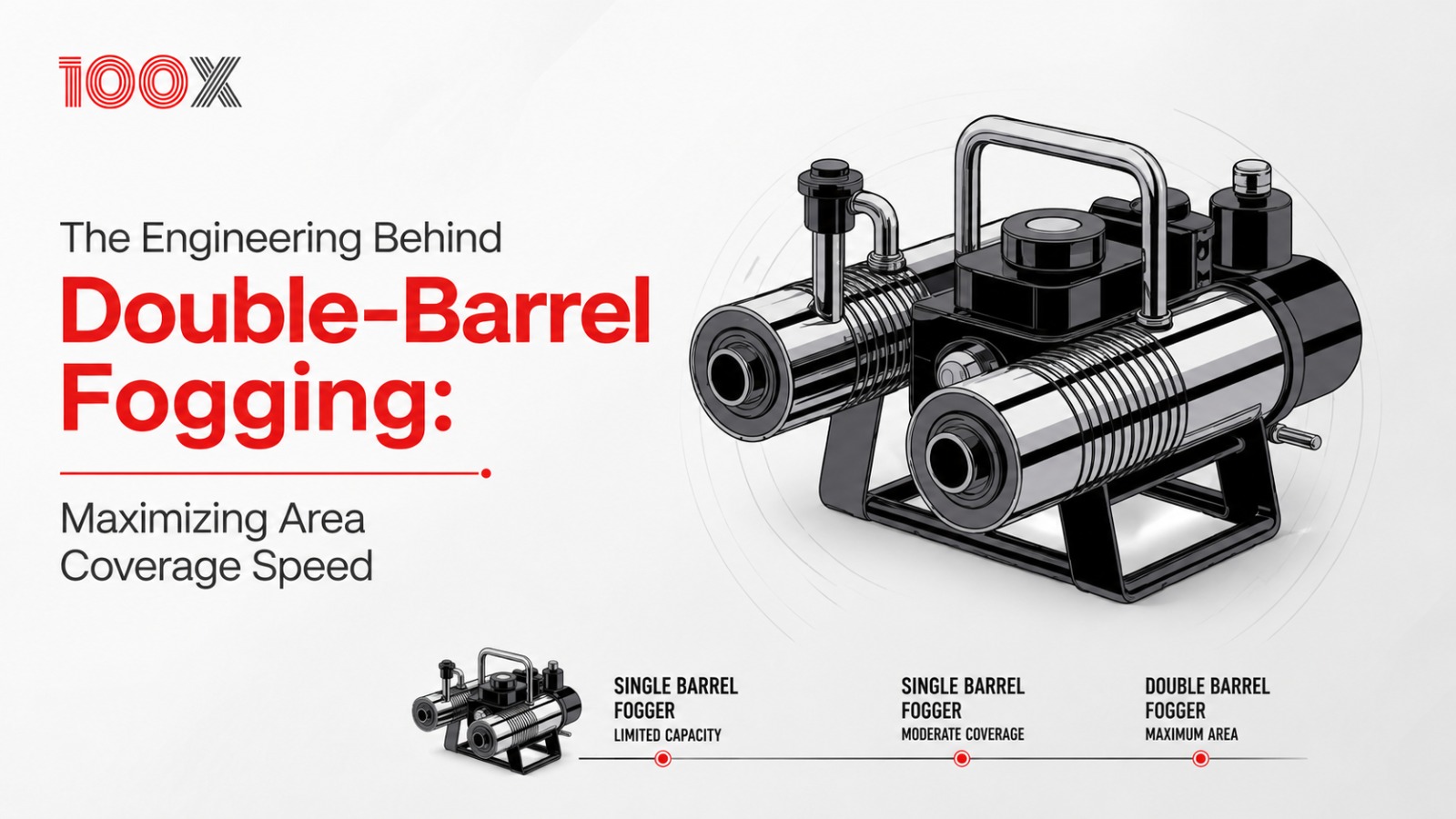
The Engineering Behind Double-Barrel Fogging: Maximizing Area Coverage Speed
The Engineering Behind Double-Barrel Fogging: Maximizing Area Coverage Speed
When a hand operated fogging unit is simply not enough, operators reach for something bigger. Municipal teams running dengue prevention drives across densely packed urban zones, agricultural contractors treating thousands of acres in a single season, and industrial disinfection crews covering logistics parks that span multiple football fields all share one operational reality: coverage speed determines outcomes.
The double barrel thermal fogging machine was engineered to answer exactly that challenge. By running combustion chambers in a single unit, it produces fog volume and throw distance that a standard single-barrel fogger cannot match. Understanding how it works and why those engineering choices matter in the field is what this article is about.
Whether you are evaluating equipment for a new vector control programme, scaling up an existing pest management operation, or simply want to understand what separates high-output fogging systems from standard alternatives, the details ahead will give you a clear picture.
What is a Double Barrel Thermal Fogger and How Does It Differ?
At first glance, a double barrel fogger looks like a larger, more industrial version of the handheld single-barreled units used for smaller-scale applications. But the difference goes much deeper than physical size. The core distinction lies in its dual combustion system, which changes the performance envelope fundamentally.
A standard single-barrel thermal fogger operates one pulse jet engine, one combustion tube, and one nozzle assembly. It produces consistent fog output for moderate coverage needs. A double barrel thermal fogging machine, by contrast, runs two complete pulse jet systems in tandem, effectively doubling the thermal energy available for vaporisation and the fog output volume per operating minute.
This is not simply two machines bolted together. The two resonators tubes are tuned and synchronised to work in coordination, which requires precise engineering of the combustion timing, fuel delivery, and exhaust gas management to prevent interference between the two chambers. Getting that tuning right is what separates well-engineered double barrel units from poorly designed ones that vibrate excessively or produce uneven fog output across the two nozzles.
Single Barrel vs. Double Barrel: Key Differences at a Glance
• Fog output volume: A double barrel unit typically produces 50 to 100 litres of chemical fog per hour compared to 25 to 30 litres from a comparable single-barrel fogger.
• Area coverage rate: Double barrel configurations can treat 4 to 8 hectares per hour depending on terrain and chemical dispersion requirements, roughly double the rate of single-barrel alternatives.
• Throw distance: Dual resonator systems generate significantly higher exhaust velocity, projecting fog up to 10 to 12 metres from the nozzle compared to 6 to 8 metres for standard units.
• Fuel consumption: Running two resonators naturally increases fuel use, but the output-per-litre efficiency of a well-engineered double barrel unit remains competitive because coverage rates scale proportionally.
• Operational weight and mounting: Most double barrel units are designed for vehicle mounting, given their size and output, though some heavy-duty portable variants exist for large-footprint indoor applications.
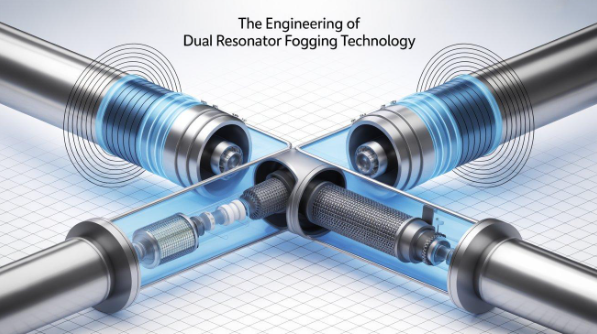
The Engineering of Dual Resonator Fogging Technology
The pulse jet resonator is the heart of any thermal fogger. It creates the rapid combustion cycles that generate the extreme heat required to vaporise chemical solutions into fine fog particles. In a double barrel configuration, two of these resonators must work together without creating interference, pressure imbalances, or uneven thermal output between the two sides.
Dual resonator fogging technology involves careful management of the acoustic resonance patterns generated by each combustion chamber. Pulse jet engines operate on a pressure-wave cycle of around 90 to 100 pulses per second. When two chambers fire in the same housing, their pressure waves must be phased correctly to avoid destructive interference that would cause misfires, vibration damage, or uneven fog density from the two nozzles.
How Resonator Synchronisation is Achieved
Achieving stable dual-resonator operation requires precision at multiple levels of the design. Here is how leading manufacturers address the core engineering challenges:
• Combustion tube length matching: Both tubes must be machined to identical internal dimensions to ensure matching resonance frequencies. Even a 2 to 3 millimetre variance can create noticeable phase drift under extended operation.
• Shared fuel delivery manifold: A common fuel feed system with precisely calibrated flow splitters ensures both resonators receive equal fuel volume at identical pressure, preventing one side from running rich or lean relative to the other.
• Independent ignition circuits: Each resonator has its own ignition system to allow independent starting and stopping if one side requires service during a multi-session operation.
• Vibration-dampened mounting frame: The combined resonance of two firing chambers requires a reinforced, vibration-dampened frame to protect both the machine structure and the vehicle or mounting platform it is attached to.
• Exhaust gas separation: Dedicated exhaust pathways for each chamber prevent cross-contamination of combustion gases, which would affect the thermal efficiency of both resonators over time.
Getting all of these engineering elements right consistently, at scale, across every unit produced, is what defines the quality gap between leading manufacturers and lower-cost alternatives in this product category.
High-Speed Area Coverage: Why Double Barrel Configurations Dominate Large-Scale Operations
For operations where coverage speed is the primary variable, no single-barrel fogger competes with a properly engineered double barrel unit. The mathematics are straightforward, but the operational implications are significant.
Consider a municipal vector control team tasked with fogging a district of 500 hectares during a dengue outbreak response. With a single-barrel vehicle-mounted fogger operating at 4 hectares per hour, that task requires 125 operating hours. With a high-speed area coverage fogger using a dual resonator system at 8 hectares per hour, the same area is covered in 62.5 hours. For outbreak response operations where timing is critical, that difference can translate directly into disease cases prevented.
Sectors Where Double Barrel Coverage Speed Matters Most
• Municipal vector control: City-wide dengue, malaria, and encephalitis prevention drives require treating large residential zones within defined weather windows, typically the hours before dawn when mosquito activity peaks and wind conditions are calm.
• Large agricultural estates: Plantation crops, orchards, and commercial vegetable farms spanning hundreds of hectares need rapid application during narrow pest intervention windows before infestation spreads.
• Industrial and logistics facilities: Warehouse complexes, cold chain hubs, and manufacturing parks often span 50,000 square metres or more and require complete fogging within single overnight sessions to avoid operational disruption.
• Post-disaster sanitation: Flood-affected areas require rapid, comprehensive fogging to control waterborne disease vectors. The ability to cover large ground quickly is operationally critical in these scenarios.
• Airport and port sanitation: International gateways face strict disinfection timelines between aircraft or vessel turnarounds, where coverage speed is a compliance requirement, not just an operational preference.
Large Scale Vector Control Equipment: Why Vehicle Mounting Changes Everything
The double barrel fogger reaches its full potential when mounted on a vehicle. The combination of high-volume fog output and vehicle mobility creates a coverage system that can treat entire city sectors in a single operating session without an operator needing to carry the equipment on foot.
Large scale vector control equipment in this configuration typically involves a flatbed or pickup-mounted double barrel unit with a dedicated chemical tank of 80 to 100 litres, a vehicle-integrated power supply, and an adjustable nozzle system that allows the operator to direct fog output while the vehicle moves at 10 to 20 kilometres per hour.
Operational Advantages of Vehicle-Mounted Double Barrel Systems
• Continuous operation: Vehicle mounting allows the fogger to operate continuously as the vehicle moves through target areas, eliminating the start-stop cycles of handheld or manually carried equipment.
• Consistent speed: Vehicle-controlled movement pace ensures uniform chemical application density across the treated area, which is critical for effective pest and vector mortality.
• Extended operational range: A vehicle-mounted unit with a 60 to 100-litre chemical tank can treat entire residential sectors or agricultural zones without refill stops.
• Operator safety: Operators remain in the vehicle cab during fogging, reducing personal chemical exposure compared to handheld operation in dense fog conditions.
• Night operation capability: Vehicle headlights and the machine's integrated mounting allow effective pre-dawn operations when mosquito activity and calm wind conditions create optimal fogging conditions.
Municipalities and large agricultural contractors who have switched from handheld to vehicle-mounted double barrel systems report coverage rate improvements of 300 to 500 per cent per operator, with significantly better coverage consistency across treated zones.
Heavy-Duty Vehicle Mount Fogger India: Meeting the Demands of Large-Scale Operations
The Indian market for vehicle-mounted fogging equipment has grown substantially over the past decade, driven by expanding municipal vector control budgets, the rise of professional pest management companies serving large commercial clients, and the Government of India's push for standardised equipment procurement through platforms like GeM.
A quality heavy-duty vehicle mount fogger India-based manufacturers produce today is substantially different from the equipment available even five years ago. Modern vehicle-mount systems feature reinforced steel mounting frames, vibration-dampened equipment beds, integrated chemical supply plumbing, and electronic controls that allow the driver to adjust fog output and chemical flow from the vehicle cab without stopping operations.
What to Look For in a Vehicle-Mount Double Barrel System
• Frame construction: Heavy-gauge steel frames with proper cross-bracing are essential for stability at operating speeds and for protecting the fogger from road vibration damage over thousands of kilometres of field use.
• Chemical tank capacity and material: Stainless steel tanks of 80 litres or more with properly sealed connections and secure mounting prevent spills on uneven terrain and ensure chemical integrity throughout operations.
• Nozzle adjustability: nozzle adjustment allows operators to direct fog into roadside vegetation, building facades, drainage channels, or crop rows depending on the application.
• Remote controls: Cab-accessible controls for chemical flow, ignition, and fog volume adjustment allow single-operator vehicle-mount operation without stopping the vehicle.
• Compatibility with standard vehicles: Well-designed mounting systems accommodate a range of standard pickup trucks and light commercial vehicles, avoiding the need for dedicated custom vehicles that increase procurement costs.
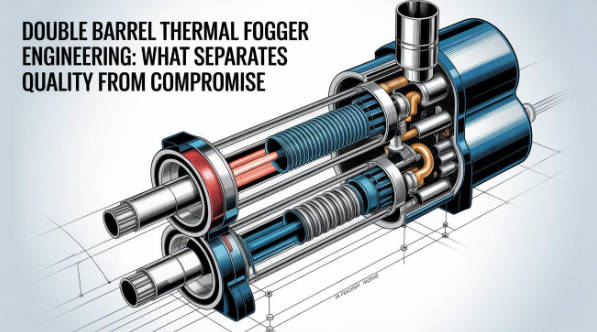
Double Barrel Thermal Fogger Engineering: What Separates Quality from Compromise
Buying a double barrel fogger based on price alone is one of the most common mistakes procurement teams make. Two combustion chambers on a poorly engineered frame create problems that a single-barrel unit never would. Resonator misalignment, inadequate vibration management, and shared exhaust pathways are design shortcuts that cause premature failure and uneven fog output in the field.
The engineering of double barrel thermal fogger engineering worth investing in shows up in specific, verifiable design features. Buyers who know what to look for can distinguish genuine quality from machines that look similar on paper but will not survive a full monsoon season of daily municipal operations.
Engineering Quality Indicators to Evaluate Before Purchase
• Combustion tube material and wall thickness: High-grade stainless steel tubes with a minimum wall thickness of 1 millimetres maintain structural integrity through the thermal cycling of heavy daily use without warping or cracking.
• Nozzle precision and replaceability: Precision-machined nozzle assemblies with replaceable tips ensure consistent fuel injection throughout the machine's lifespan and keep long-term service costs manageable.
• Fuel system quality: A dual-feed fuel system with individual flow regulators for each resonator allows precise tuning of both sides independently, which is essential for maintaining balanced output as components wear over time.
• Mounting frame certification: Frames designed for vehicle mounting should be load-rated and tested for the specific vibration profiles generated by double barrel operation at speed on uneven terrain.
Taking the time to verify these specifications before purchasing protects procurement budgets and field operations from the cost of premature equipment failure or unreliable performance at critical operational moments.
Choosing the Right Double Barrel System for Your Operation
The right double barrel unit is the one that matches your specific operational profile. A municipal agency conducting nightly urban fogging drives has different requirements from an agricultural contractor treating paddy fields, which in turn differs from an industrial facility manager scheduling monthly warehouse disinfection cycles.
Operators across India who have moved to double barrel vehicle-mount configurations, including those running equipment from 100X Circle, consistently report that the upfront investment in higher-output equipment pays back in reduced operational hours, lower per-hectare treatment costs, and improved results across client sites. The key is matching the machine specification to the operational load it will actually face.
Questions to Ask Before Selecting a Double Barrel Fogger
• What is the average area to be treated per operating session? This determines whether a double barrel system is operationally justified or whether a high-output single-barreled unit would suffice.
• Will the machine be vehicle-mounted or operated on foot? Vehicle-mount configurations require additional assessment of the mounting platform, vehicle compatibility, and remote control requirements.
• What chemical formulations will be used? Confirm that the machine's wetted parts are compatible with the specific pesticide or disinfectant formulations planned for use.
• What is the expected annual operating hours? High-use operations require machines built to commercial-grade durability standards with accessible spare parts and a service network in the deployment region.
• What after-sales Spare parts support is available locally? For vehicle-mounted double barrel systems used in critical public health or agricultural operations, spare parts availability is not a preference but a procurement requirement.
High-Speed Area Coverage Foggers: The Operational Impact in Real Numbers
It is worth grounding the engineering discussion in the operational outcomes that matter to practitioners. Here are some representative performance benchmarks from vehicle-mounted double barrel operations in Indian field conditions:
• Urban vector control: A vehicle-mounted double barrel unit operating at 15 kilometres per hour in dense residential streets can treat approximately 8 to 10 hectares of built-up area per hour, including roadside vegetation and drainage corridors.
• Agricultural application: In open field conditions, the same configuration can cover 12 to 15 hectares per hour for broad-spectrum insecticide applications on low-canopy crops.
• Industrial facility disinfection: A 20,000 square metre warehouse with racking up to 12 metres can typically be fogged in 35 to 45 minutes with a double barrel unit positioned at multiple access points.
• Fuel efficiency: Modern double barrel units operating at full output consume approximately 3 to 4 litres of fuel per hour, making fuel cost a manageable operational input relative to the area coverage achieved.
These numbers illustrate why procurement decisions increasingly favour high-speed area coverage foggers for any operation where coverage of more than 5 hectares per session is a routine requirement. The time and labour cost savings over a full operational season justify the higher equipment investment many times over.
Large Scale Vector Control Equipment: What the Data Tells Us About Effectiveness
Coverage speed is only valuable if the fog being distributed is actually achieving pest or vector mortality at the target rates. The engineering of the double barrel unit contributes to effectiveness in ways that go beyond simple volume.
Large scale vector control equipment using dual pulse jet technology produces fog with a more consistent particle size distribution than single-barrel alternatives, because the higher thermal energy available from two combustion chambers maintains vaporisation efficiency across a wider range of chemical viscosities and ambient temperature conditions.
Field studies comparing single and double barrel fogging outcomes in mosquito control programmes have found that double barrel units consistently achieve higher adult mosquito knockdown rates in treated areas, attributed partly to the greater fog penetration into dense vegetation and narrow spaces that the higher exhaust velocity delivers.
For public health procurement agencies evaluating equipment on the basis of cost per disease case prevented, this effectiveness advantage adds a further dimension to the value case for double barrel systems beyond their obvious coverage speed benefits.
Final Thoughts
The engineering behind a double barrel thermal fogger is considerably more involved than simply fitting two exhaust tubes to a single chassis. Resonator synchronisation, fuel system balance, vibration management, and nozzle precision engineering all have to come together correctly for the machine to deliver on its potential.
When that engineering is done well, the result is a piece of equipment that transforms the economics and effectiveness of large-scale fogging operations, whether in urban vector control, commercial agriculture, industrial disinfection, or post-disaster sanitation response.
For operations that have outgrown single-barrel fogging and are ready to move to professional-grade double barrel systems, explore the range of vehicle-mounted and high-output thermal foggers at 100x Circle. Built for the demanding field conditions of Indian operations and proven across large-scale vector control and agricultural programmes, the range covers what serious operators actually need.
Frequently Asked Questions (FAQs)
Q1. What is the main advantage of a double barrel thermal fogging machine over a single-barrel model?
A double barrel thermal fogging machine runs two combustion chambers simultaneously, roughly doubling fog output volume, throw distance, and area coverage rate compared to a single-barrel unit, making it the preferred choice for large-scale municipal, agricultural, or industrial fogging operations.
Q2. How does dual pulse jet fogging technology ensure consistent fog output from both nozzles?
Manufacturers achieve consistent dual-barrel output by matching the internal dimensions of both combustion tubes to identical resonance frequencies, using a shared or separate fuel manifold with calibrated flow splitters, and fitting independent ignition circuits that allow each resonator to be tuned and controlled separately.
Q3. Is a double barrel fogger suitable for handheld use or is vehicle mounting required?
Most double barrel units are engineered for vehicle mounting due to their size and output capacity, though some heavy-duty portable variants exist for large indoor applications; for outdoor area coverage at scale, vehicle mounting is the standard configuration as it combines the machine's high output with the mobility needed for practical large-area operations.
Q4. What chemical types can be used with a double barrel thermal fogger?
Double barrel thermal foggers are compatible with a wide range of WHO-approved insecticides, agricultural pesticides, and disinfectant formulations, provided the chemical is in the correct oil-based or water-based formulation suitable for thermal vaporisation; always confirm compatibility with the manufacturer before use with new formulations.
Q5. How do I maintain a double barrel thermal fogger for long-term performance?
Key maintenance practices include flushing both chemical tanks and feed lines after every use, cleaning both nozzle assemblies weekly, checking fuel line integrity and spark plugs at weekly intervals, and performing a full carburettor service on both resonator systems every 3 months, depending on operational frequency.
Related Images
100X
Article Author